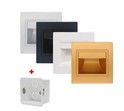
In the contemporary era, energy efficiency has emerged as a pivotal concern in the design and utilization of lighting solutions. As a supplier of Outdoor Smart Step Lamps, I am frequently asked whether these innovative lighting fixtures are truly energy - efficient. In this blog post, I will delve into the technical aspects, cost - effectiveness, and environmental impact of outdoor smart step lamps to provide a comprehensive answer to this question.
Technical Aspects of Energy Efficiency
One of the primary factors contributing to the energy efficiency of outdoor smart step lamps is the use of LED technology. Light - Emitting Diodes (LEDs) are known for their high luminous efficacy, which is the measure of how well a light source produces visible light. Compared to traditional incandescent bulbs, LEDs can convert a significantly higher percentage of electrical energy into light, rather than wasting it as heat. For instance, incandescent bulbs typically have a luminous efficacy of around 10 - 17 lumens per watt, while high - quality LEDs can achieve 80 - 120 lumens per watt or even higher. This means that for the same amount of light output, an LED - based outdoor smart step lamp consumes far less electricity.
Another technical feature that enhances energy efficiency is the smart control functionality. Our outdoor smart step lamps are equipped with sensors such as motion sensors and ambient light sensors. Motion sensors detect the presence of people or vehicles in the vicinity of the step lamp. When no movement is detected, the lamp can automatically dim or turn off, conserving energy. Ambient light sensors, on the other hand, adjust the brightness of the lamp according to the natural light available. During the day, when there is ample sunlight, the lamp can remain off or operate at a very low brightness level. As the ambient light decreases in the evening, the lamp gradually increases its brightness to provide adequate illumination.
Cost - Effectiveness
From a cost - effectiveness perspective, outdoor smart step lamps are a smart investment in the long run. Although the initial purchase price of these lamps may be higher than that of traditional step lights, the energy savings over time can offset the upfront cost. Let's take a simple example. Suppose you have a set of 10 outdoor step lamps, and each traditional incandescent lamp consumes 60 watts of power. If these lamps are used for an average of 6 hours per day, the total daily energy consumption would be 10 lamps × 60 watts × 6 hours = 3600 watt - hours or 3.6 kilowatt - hours (kWh). Assuming an electricity cost of $0.15 per kWh, the daily cost of operating these lamps would be 3.6 kWh × $0.15 = $0.54. Over a year, this would amount to $0.54 × 365 = $197.1.
In contrast, if you replace these incandescent lamps with our outdoor smart step lamps, which use LED technology and smart controls, the energy consumption can be significantly reduced. Let's assume that each smart step lamp consumes only 10 watts on average, and due to the smart control features, they are actually in operation for only 3 hours per day. The total daily energy consumption would be 10 lamps × 10 watts × 3 hours = 300 watt - hours or 0.3 kWh. The daily cost of operating these lamps would be 0.3 kWh × $0.15 = $0.045. Over a year, this would amount to $0.045 × 365 = $16.425. This represents a substantial savings of approximately $180.675 per year.
Environmental Impact
In addition to cost savings, outdoor smart step lamps also have a positive environmental impact. The reduced energy consumption means a lower demand for electricity generation. Most electricity is currently generated from fossil fuels such as coal, oil, and natural gas, which release greenhouse gases like carbon dioxide into the atmosphere when burned. By using energy - efficient outdoor smart step lamps, we can reduce our carbon footprint and contribute to the fight against climate change.
Moreover, LEDs have a longer lifespan compared to traditional bulbs. Incandescent bulbs typically last for about 1000 - 2000 hours, while LEDs can last for 25,000 - 50,000 hours or more. This means fewer bulbs need to be replaced over time, reducing the amount of waste sent to landfills.
Product Range and Applications
As a supplier, we offer a wide range of outdoor smart step lamps to meet different customer needs. Our Outdoor Landscape Step Light is designed to blend seamlessly with the outdoor landscape. It provides soft, even illumination that enhances the beauty of gardens, pathways, and outdoor living spaces. The lamp is made of high - quality materials that are resistant to weather and corrosion, ensuring long - term durability.
Our Outdoor Ip65 Step Light is specifically designed for harsh outdoor environments. The IP65 rating means that the lamp is completely protected against dust ingress and can withstand low - pressure water jets from any direction. This makes it suitable for use in areas prone to heavy rain, snow, or high humidity.
For those looking to add a decorative touch to their outdoor corners, our Outdoor Garden Corner Lamp is an excellent choice. It features a unique design that can create a warm and inviting atmosphere in garden corners, fence lines, or patio areas.
Conclusion and Call to Action
In conclusion, outdoor smart step lamps are indeed energy - efficient. Their use of LED technology, smart control features, and long lifespan make them a cost - effective and environmentally friendly lighting solution for outdoor spaces. Whether you are a homeowner looking to enhance the safety and beauty of your property or a commercial developer in need of reliable outdoor lighting, our outdoor smart step lamps can meet your requirements.
If you are interested in learning more about our products or would like to discuss a potential purchase, please feel free to reach out. We are committed to providing high - quality products and excellent customer service. Let's work together to create energy - efficient and beautiful outdoor lighting solutions.


References
- "LED Lighting Basics." U.S. Department of Energy.
- "Energy Efficiency and Renewable Energy." Environmental Protection Agency.
- "The Impact of Smart Lighting on Energy Consumption." Journal of Sustainable Energy Technologies and Assessments.