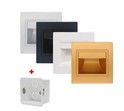
When selecting outdoor wall lights, one of the most crucial factors to consider is the appropriate brightness. The right level of brightness can transform your outdoor space, enhancing both safety and aesthetics. As an outdoor wall light supplier, I've witnessed firsthand how the correct lighting choices can make a significant difference. In this blog, I'll share some insights on how to choose the right brightness for outdoor wall lights.
Understanding Lumens: The Measure of Brightness
Before delving into the selection process, it's essential to understand the concept of lumens. Lumens measure the total amount of visible light emitted by a light source. Unlike watts, which measure energy consumption, lumens directly indicate the brightness of a light. The higher the lumen value, the brighter the light.
Factors Influencing Brightness Requirements
Several factors influence the ideal brightness for outdoor wall lights. Let's explore these factors in detail:
Location and Purpose
The location and intended purpose of the outdoor wall lights play a significant role in determining the appropriate brightness. For example, lights installed near entrances, pathways, or stairways require higher brightness levels to ensure safety and visibility. In contrast, lights used for decorative purposes, such as accentuating architectural features or creating a mood, may require lower brightness levels.
- Entrances and Pathways: Entrances and pathways are high-traffic areas that require sufficient lighting to prevent accidents. Aim for wall lights with a lumen output of at least 500 - 1000 lumens for these areas. 12W Modern Sconce Stair Wall Light is an excellent choice for stairways, providing bright and uniform illumination.
- Security Lighting: If security is a concern, consider installing wall lights with motion sensors and high lumen outputs. These lights can deter intruders by illuminating the area when motion is detected. Look for lights with a lumen output of 1000 - 3000 lumens or more for effective security lighting.
- Decorative Lighting: Decorative wall lights are used to enhance the aesthetic appeal of outdoor spaces. These lights typically have lower lumen outputs, ranging from 100 - 500 lumens. Vintage Wall Mounted Aluminum Wall Light adds a touch of elegance to any outdoor setting with its warm and inviting glow.
- Balconies and Patios: Balconies and patios are areas where you may want to create a cozy and inviting atmosphere. Choose wall lights with a lumen output of 200 - 500 lumens for these spaces. Six - Head Exterior Wall Balcony Light provides a soft and ambient light, perfect for relaxing evenings outdoors.
Surrounding Environment
The surrounding environment also affects the brightness requirements of outdoor wall lights. If your outdoor space is surrounded by tall buildings or trees that block natural light, you may need to install brighter lights to compensate. On the other hand, if your outdoor space is well - lit by natural light, you can opt for lower brightness levels.
- Urban Areas: In urban areas, where there is a lot of ambient light from streetlights and neighboring buildings, you may not need extremely bright wall lights. However, you still need to ensure that your lights are visible and provide sufficient illumination for safety.
- Rural Areas: Rural areas typically have less ambient light, so you may need to install brighter wall lights to ensure visibility. Consider using lights with higher lumen outputs and wider beam angles to cover a larger area.
Time of Use
The time of day when you use your outdoor wall lights also influences the brightness requirements. If you primarily use your lights during the evening and night, you may need higher brightness levels to ensure visibility. However, if you also use your lights during the day for decorative purposes, you can choose lights with lower brightness levels.
Choosing the Right Bulb Type
In addition to considering the lumen output, you also need to choose the right bulb type for your outdoor wall lights. Different bulb types have different characteristics, such as color temperature, energy efficiency, and lifespan.
- LED Bulbs: LED bulbs are the most popular choice for outdoor wall lights due to their energy efficiency, long lifespan, and versatility. LED bulbs can produce a wide range of colors and brightness levels, making them suitable for various applications. They also consume less energy than traditional incandescent or halogen bulbs, which can save you money on your energy bills in the long run.
- Halogen Bulbs: Halogen bulbs produce a bright, white light and are relatively inexpensive. However, they are less energy - efficient than LED bulbs and have a shorter lifespan. Halogen bulbs also generate a significant amount of heat, which can be a safety concern in some applications.
- Fluorescent Bulbs: Fluorescent bulbs are energy - efficient and have a long lifespan. However, they may not be suitable for all outdoor applications due to their lower color rendering index (CRI) and slower startup time.
Beam Angle and Distribution
The beam angle and distribution of your outdoor wall lights also affect the brightness and coverage of the light. The beam angle refers to the angle at which the light is emitted from the bulb, while the distribution refers to how the light is spread across the area.
- Narrow Beam Angle: Lights with a narrow beam angle (less than 30 degrees) are ideal for highlighting specific objects or areas, such as architectural features or plants. These lights can create a dramatic effect but may not provide sufficient illumination for large areas.
- Wide Beam Angle: Lights with a wide beam angle (greater than 90 degrees) are suitable for illuminating large areas, such as entrances, pathways, and patios. These lights provide a more uniform and diffused light, which can enhance safety and visibility.
Dimming Options
Dimming options can add flexibility to your outdoor lighting system. With dimmable wall lights, you can adjust the brightness according to your needs and preferences. This can help you create different moods and save energy when full brightness is not required.
Conclusion
Choosing the right brightness for outdoor wall lights is essential for enhancing safety, aesthetics, and energy efficiency. By considering factors such as location, purpose, surrounding environment, time of use, bulb type, beam angle, and dimming options, you can select the perfect wall lights for your outdoor space.


As an outdoor wall light supplier, we offer a wide range of high - quality wall lights to meet your specific needs. Whether you're looking for bright and functional lights for entrances and pathways or soft and decorative lights for balconies and patios, we have the perfect solution for you.
If you're interested in purchasing outdoor wall lights or have any questions about choosing the right brightness, please feel free to contact us. We're here to help you make the best lighting decisions for your outdoor space.
References
- Lighting Research Center. (n.d.). Understanding Lumens. Retrieved from [Website of Lighting Research Center]
- Energy Star. (n.d.). Outdoor Lighting. Retrieved from [Website of Energy Star]